
Why I Started Buying Physical Media Again — and What the Numbers Say
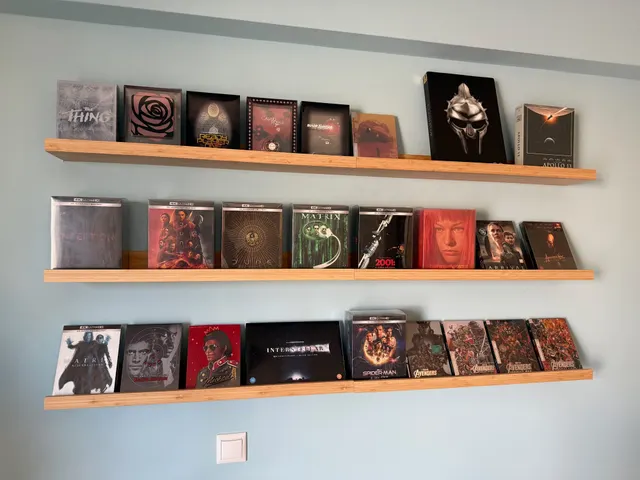
Since around the middle of 2025, I have found myself buying and collecting physical media again. 4K Blu-rays, Steelbooks and collector editions have gradually started filling the shelves above my desk, while more recently vinyl has entered the picture too.
There is something slightly ironic about this. I have spent most of my professional life working with technology, digital transformation and cloud services, where removing friction is almost always considered a good thing. I am also heavily invested in the Apple ecosystem and have absolutely no intention of abandoning digital media. Apple Music is still how I listen to most music, while Disney+ and Netflix cover much of our movie and television streaming at home. Being able to access almost any song, album or film within seconds is one of those technological changes we very quickly learned to take for granted.
And yet, somewhere along the way, I started enjoying some of that friction again.
Not everywhere. Just where it adds something.
What surprised me even more was that vinyl, the oldest format in this story, was not really driven by nostalgia for my own past. It started with my daughter.
From Covent Garden to the first “tsi tsik”
We were walking around Covent Garden in London, exploring shops together. I was doing my usual thing, looking for Arrow Video Blu-rays, when my daughter spotted some Billie Eilish records. Billie is one of her favourite artists, so naturally she asked if she could buy a few.
I didn't have much of a vinyl collection myself. I owned a few Michael Jackson records, but I had never properly got into the format. My father had some Elvis Presley records when I was growing up and I listened to them occasionally, so vinyl was familiar to me, but I can't really claim that I was returning to some great record collection from my youth.
In a strange way, my daughter and I were starting almost from the same place.
We spent time looking through the records, examining the artwork and deciding what she wanted. It was already very different from typing “Billie Eilish vinyl” into a search box and pressing Buy Now. Then, having bought the records, we discovered the obvious flaw in our plan: we didn't actually have a turntable.
So we ordered one.
When it arrived, the setup became another activity we did together. We opened everything, assembled it, balanced the tonearm, connected it to my AV system and worked through how everything operated. Eventually we were ready, her first record went onto the platter and the stylus came down.
After listening for a little while, she looked at me and asked:
“What is this ‘tsi tsik’ sound?”
She meant the little crackles in the background.
For somebody who has grown up with Apple Music, YouTube and digitally clean playback, surface noise was something completely new. Technically, of course, that crackle is not a feature. Vinyl does not magically become a more accurate audio format just because it is analogue, and I am not going to try to make an audiophile argument that every record sounds better than a good digital master.
That isn't what stayed with me anyway.
What I remember is the two of us sitting in the living room listening to her music after having gone through the whole process together: finding the records in London, buying them, waiting for the turntable, setting everything up and finally hearing them play.
We still do it now, and somewhere along the way that little “tsi tsik” stopped being an imperfection I noticed and became part of a memory I enjoy.
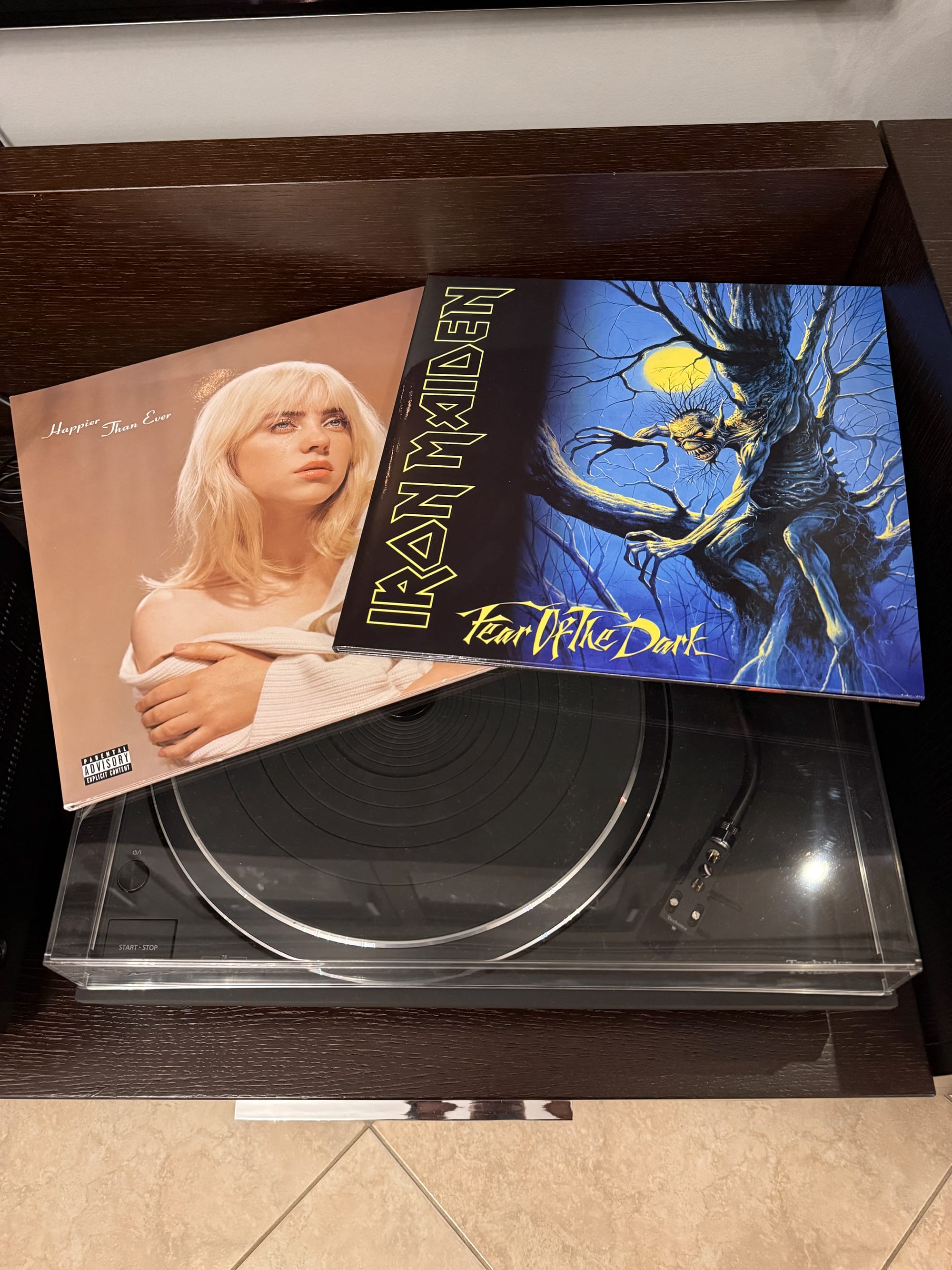
My turntable with Billie Eilish’s Happier Than Ever, one of the records my daughter chose in Covent Garden, alongside Iron Maiden’s Fear of the Dark from the metal side of my collection.Then more than 50 records arrived
My vinyl collection took another unexpected turn when my friend Dimitris gave me more than 50 records from his own collection, mainly metal.
We have been friends for more than ten years, but what makes those records particularly important is that Dimitris is also the person who properly introduced me to the metal scene. He is the friend I go to concerts with. Last year we went to Wacken together, and in 2026 our concert calendar has included names such as Iron Maiden, Helloween and Sabaton.
So when he helped kick-start my collection with records from his own shelves, they arrived with something that no new copy ordered online could really have.
History.
They were records he had chosen, owned and listened to, from music that had already become part of our friendship. Now part of that collection was becoming the starting point for mine.
That made me think about one of the characteristics of physical media that is easy to overlook. A physical object can move between people while carrying a story with it. It can be given away, borrowed, sold, inherited or passed to a friend, and its history doesn't necessarily disappear when ownership changes.
Of course, digital music can be shared too. Dimitris can send me an Apple Music playlist containing exactly the same albums.
But it doesn't feel quite the same.
What felt at first like a very personal ritual—buying records with my daughter, setting up a turntable, receiving part of a friend's collection—turns out to sit inside a much broader behavioural shift. The numbers suggest that vinyl is not simply being kept alive by an ageing audience refusing to move on.
UK vinyl revenue increased another 19.9% in 2025 to £174.7 million, marking 16 consecutive years of revenue growth. Contemporary releases remain among the strongest sellers, and the BPI has specifically highlighted the growing appeal of vinyl among younger listeners. Physical music overall also grew, with ERA reporting an 11.5% increase in consumer spending in 2025 to £368.1 million.
Vinyl really has come back.
The more interesting question, though, is why anyone chooses to buy physical media at all when access to the same content has never been easier.
Friction can have value
Streaming solved a real problem. I don't want to return to a world where discovering an album means paying for it before I even know whether I like it, and I certainly don't miss searching a video store only to discover that the movie I wanted had already been rented.
Digital won convenience. Completely.
But unlimited access creates a different kind of relationship with content. I can start an album in Apple Music, skip three tracks, move to another artist, answer a message, open something else and twenty minutes later barely remember what I originally intended to listen to.
A record asks for slightly more. You choose it, remove it from the sleeve, put it on the turntable and lower the stylus. None of these things is difficult, but together they amount to a small commitment: this is what we are listening to now. We tend to stay there longer, hear songs we might otherwise have skipped and talk while the album is playing.
The album becomes an album again rather than ten individual tracks competing for attention.
This doesn't mean we have stopped streaming. Quite the opposite. We stream almost everything, and then occasionally something becomes important enough that we want to own it.
I have started thinking of this as selective physical ownership.
Digital remains the default for discovery and access. Physical media comes in when the content earns a different level of attention.
And that brings me to movies.
Three copies of a movie we had already seen
Recently my daughter and I opened a Manta Lab Spider-Man: No Way Home One Click.
If you collect premium physical movies, that sentence probably makes perfect sense. If you don't, the reaction may be closer to the one my wife had while watching us.
Genuine confusion.
A Manta Lab One Click is a collector's box containing multiple premium editions of the same film, each with different artwork and presentation, together with booklets, cards and other collectible material. My daughter knew beforehand that the box contained three different releases, so there was no surprise about the basic contents.
We also certainly didn't need it to gain access to the movie. We knew the film already.
We opened everything together and started going through the contents. My daughter immediately loved the stickers and mini cards, while we compared the different artwork and packaging. Her favourite was the lenticular full slip with Spider-Man and Doctor Strange, despite being a very big Tom Holland and Zendaya fan.
Then we moved onto the discs and watched bonus material we had never explored before, including the gag reel and other behind-the-scenes content.
My wife was standing nearby watching all this unfold. It was the first time she had seen us open a Manta Lab One Click and she was genuinely trying to understand why we were so excited.
And I understand her.
From outside the hobby, three premium editions of a film you already know can look completely absurd. You could open a streaming service and be watching something within seconds.
But that wasn't what we were doing.
We were exploring it.
We were looking at artwork, comparing editions, discovering extras, discussing what each of us liked and enjoying the process of opening something we had been waiting for. The movie was at the centre of the experience, but simply watching the movie was no longer the whole experience.
There is also a more practical reason why I still value 4K discs. A well-authored UHD Blu-ray can deliver substantially higher and more consistent video bitrates than typical 4K streaming, together with lossless audio formats such as Dolby TrueHD or DTS-HD Master Audio where included. On a good home-cinema setup, particularly in difficult dark scenes or fast-moving material, that additional data and consistency can still make a visible and audible difference.
Streaming wins convenience. The disc can still win presentation.
There is a preservation dimension too. Streaming catalogues change, films move between services, and digital access ultimately remains dependent on platforms, licensing arrangements and service availability. A self-contained disc sitting on my shelf is much simpler: nobody can remotely delist it from the shelf above my monitor.
That doesn't make physical media immortal. Discs can fail and players will eventually become harder to find. But the relationship is fundamentally different.
And the market seems to be reflecting exactly that distinction.
If you look only at the headline numbers, physical movies are absolutely not experiencing a vinyl-style comeback. UK consumer spending on physical video fell from roughly £1.08 billion in 2015 to £148.9 million in 2025, an extraordinary decline of around 86% over the decade.
The DVD mass market has largely collapsed.
Look underneath that decline, however, and a different behaviour starts to appear. In 2025, UK 4K UHD value increased by 19.5%, while Steelbooks represented only around 10% of available 4K titles but generated approximately 18% of 4K revenue.
That statistic resonates with me because I am quite literally one of the consumers behind it.
The old DVD was primarily a way to get the movie. A premium 4K Steelbook or Manta Lab edition is increasingly something you buy because you already care about the movie.
That is a very different business.
The shelf itself has value
There is another aspect of collecting which doesn't fit particularly well into a sales chart. My movie collection is displayed on shelves directly above the monitor where I work, which means I probably look at it more than I consciously realise. During the day, particularly when I want to disconnect for a moment, I sometimes just sit back and look at the shelves.
I find it relaxing.
Different editions remind me of different things: searching for a particular release, finding one that had become difficult to buy, watching a film with my daughter, or simply discovering artwork that I really liked. The collection is gradually becoming connected to experiences rather than just titles.
A streaming library can give me thousands of thumbnails. My shelf gives me considerably fewer films, but every one is there because at some point I chose it.
That limitation matters.
So, is physical media really coming back?
After looking at ten years of data, I don't think “physical media is back” is the right conclusion. Some of it is. Some of it never really went away. Some continues to decline, while other parts are transforming into premium products for people willing to spend more on fewer things.
Vinyl is the clearest genuine revival. CDs are showing some signs of stabilisation, although it is too early to describe that as another vinyl story. Physical video remains in structural decline, but 4K UHD and collector editions are growing inside that shrinking market.
Physical games remain significant too, although the definition of “physical” is becoming increasingly blurred. Nintendo's Switch 2 Game-Key Cards, for example, are transferable physical objects but require the game itself to be downloaded.
Books may actually be the most useful comparison. Print never disappeared in the first place. Nobody had to manufacture a “physical book comeback” because the book remained useful enough as a physical object that digital alternatives never fully replaced it.
Perhaps music and movies are rediscovering some of the same thing.
Stream everything. Own what matters.
I don't think physical media needs to defeat streaming, and I certainly don't want it to. Streaming is better at access, discovery and convenience. Physical media increasingly gives me something else: participation, selection, ownership and connection. There are steps between wanting something and consuming it—going to the shop, choosing it, opening it, setting something up, putting it on a shelf, sharing it with somebody else.
In most areas of technology, we spend enormous effort trying to remove those steps. Often, that is exactly the right thing to do. But sometimes the steps are where the memory happens.
The Billie Eilish records are now connected in my head with Covent Garden, my daughter spotting them while I was searching for Blu-rays, the arrival of the turntable, the two of us balancing the tonearm and eventually hearing that first “tsi tsik.”
The metal records connect to Dimitris, the person who introduced me properly to that music, more than a decade of friendship, concerts and Wacken.
And Spider-Man: No Way Home now includes the memory of my daughter and me opening three editions of a movie we already knew, getting excited over lenticular artwork, stickers and cards, while my wife stood next to us trying to work out what on earth we found so fascinating.
None of this makes streaming worse. It simply makes physical media something different.
When physical media was effectively the only way to access much of this content, we bought volume. Now that access has become almost frictionless, many of us seem to be buying with much more intention.
Perhaps that is the real transformation.
We no longer need to own most of what we consume, which makes the decision to physically own something more deliberate—and, at least for me, more meaningful.
Stream everything. Own what matters.
Sometimes even the “tsi tsik” matters.
