
Giving AI permission to investigate a problem is a different decision from giving it authority to change production. Faster analysis matters, but its value depends on whether the organization can turn a finding into an appropriate action, within an acceptable time and with control over the consequences.
Engineering security at machine speed means deciding in advance where machines may act, providing the context and controls that make those actions dependable, and proving that the complete workflow reduced exposure without creating unacceptable business consequences. The remediation, cost and resilience constraints explored earlier now need to shape how security operates.
Speed is built before the incident
A severity score can signal urgency, but it cannot establish who may authorize a production change, which services the change could affect or what disruption the business will accept. Even a well-prioritized finding needs ownership, operational context and an agreed route to treatment before the teams responsible can act on it.
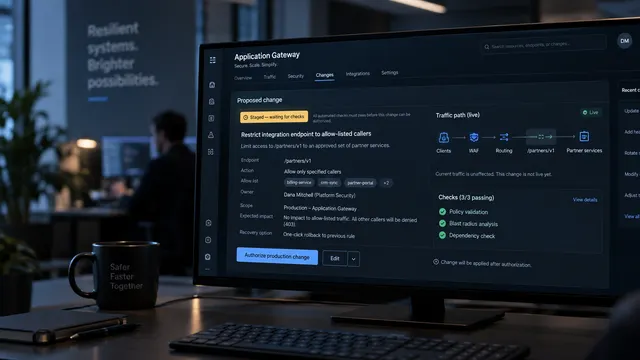
Consider a hypothetical internet-facing application supporting an important customer service. A weakness in an integration endpoint has been confirmed as reachable and exploitable from the internet, but the permanent code fix cannot yet be deployed safely. A proposed interim treatment would restrict that endpoint to approved callers through the existing application gateway, reducing its exposure without changing the application code.
That restriction is not automatically safe because it avoids a code deployment. The team must establish which customers and integrations need access, what the restriction would interrupt, which attack path it addresses and how long the interim arrangement remains acceptable.
The preparation belongs before the urgent decision: security, engineering and service owners agree the evidence required, permitted treatment options and escalation conditions, including what happens when the current situation falls outside the approved scope. AI can then assemble relevant threat intelligence, exposure data and service information without requiring an analyst to reconstruct the same context each time.
Build that capability around a few important workflows rather than wait for a perfect enterprise inventory. It supports action against validated exposures before an incident occurs, as well as faster containment afterward.
Delegate authority, not accountability
An agent’s autonomy in reasoning is different from its operational agency: the authority it has been given to act. An agent can investigate independently, compare treatment options and prepare a detailed change while remaining unable to apply it. Greater analytical independence does not require an equivalent increase in operational authority.
For the access restriction, the appropriate arrangement might be a recommendation for a person to implement, execution after explicit approval, or execution within a previously authorized scope. These are choices based on consequences and demonstrated capability, not stages every workflow must pass through toward full autonomy. The agent authorized to prepare the restriction does not automatically receive permission to extend it to neighboring services.
Authority also includes decisions that determine whether work happens at all. Closing an alert, lowering its severity or deferring remediation changes which risks receive attention, even when the agent cannot modify production. Those decisions need boundaries as deliberately as the gateway change itself.
Human authorization does not necessarily require manual execution, but it does require meaningful judgment. A reviewer needs the proposed scope, supporting evidence, expected impact and recovery options, together with the competence and time to challenge them. An approval step contributes little when the person is effectively confirming a recommendation they cannot assess.
Someone must remain accountable for the delegated scope and its results, including the decision to expand, restrict or withdraw authority. That responsibility cannot be transferred to the model, and preauthorization should remove repeated waiting without removing the conditions under which the action was permitted.
Put AI reasoning inside enforceable boundaries
The restriction also creates a potential coordination problem. An operations agent seeking to restore normal availability might interpret it as a configuration fault and attempt to remove it, while the security workflow reinstates it. Both could be pursuing legitimate objectives, yet their combined behavior would undermine protection and destabilize the service. Individually authorized actions do not establish an acceptable collective outcome.
In this workflow, the approved restriction must be visible to both systems as intentional treatment, with a defined owner and conditions for reconsideration. Availability automation may raise a conflict, but it must not independently override the security decision.
The execution controls make those agreements effective. The acting agent uses a task-scoped workload identity with short-lived credentials, while tool fencing limits its changes to the approved endpoint and parameters. Staged writes hold the proposed restriction until the required checks pass, and the execution system enforces its approved change or incident context while limiting repeated and concurrent changes.
Logs and rollback remain necessary, but they cannot substitute for controls before and during execution when an agent can chain actions faster than an operator can inspect them. Use AI where interpretation and planning add value, with conventional automation handling well-defined execution where it remains the dependable choice. Guardian agents may provide additional oversight, but should complement these boundaries rather than become the sole mechanism enforcing them.
Follow the change until the outcome is verified
After testing in proportion to operational impact, confirm that the endpoint, approved callers and service conditions still match the authorized scope, then apply the staged restriction through the controlled path.
Once applied, the restriction needs two forms of verification: that the identified external attack path is constrained, and that legitimate transactions still complete within agreed service limits. A successful gateway command establishes neither on its own. Checking that the application responds is not enough when the affected integration can no longer complete its work. The underlying weakness remains tracked, with an owner for the permanent fix and a review point for the interim protection, rather than a closed ticket suggesting the vulnerability has disappeared.
Stopping the agent is not the same as recovering the change. Responders need a tested way to contain further execution as well as deal with actions already completed. Rolling back the restriction may restore access while reopening exposure, so the response needs an approved fallback that considers both consequences. That could mean retaining a narrower restriction or accepting a defined period of degraded service while another treatment is prepared. Recovery must not rely exclusively on the agent or control path responsible for the failure.
Evidence should reconstruct who or what acted, the authority and scope granted, the change applied and the resulting state, using execution records and observations that remain available independently of the agent. Its explanation can assist investigation, but is not proof that the action was correct.
Revalidate the workflow when changes to its model, prompts, tools or operating context could alter production behavior, rather than treating the original approval as permanent.
The human work shifts toward engineering and judgment
Moving routine execution into automation changes where human effort creates value. Analysts need to own cases and evaluate evidence, while engineers need capacity to design, test and maintain the workflows through which decisions become production changes. Detection engineering needs to extend into workflow engineering, including validation, version control and the investigation of unexpected behavior.
For leadership, this means funding the capability around the agent rather than only its license. Service relationships, runbooks, evaluation cases and intervention procedures all need owners and maintenance time; adding those responsibilities to already committed teams does not make them operational.
Review must also be designed as work. Training should equip people to challenge a proposed change and understand its downstream effects, while workload planning must leave them time to do so. The organization also needs to retain the practical knowledge to operate and recover when the automated path is unavailable.
These responsibilities extend to external providers: contracts must establish their authority to act, responsibility for affected services and access to evidence, so faster ticket processing does not conceal an ownership gap between the provider and the production team.
Measure protection, not the amount of automation
Before expanding authority, establish how the workflow performs today, what improvement is expected and what must not deteriorate as it improves. This means evaluating the complete result rather than celebrating faster analysis while review effort, failed changes or operational risk increase elsewhere.
Assess the workflow across five outcome areas:
| Outcome area | What to establish |
|---|---|
| Security effect | Verified removal or constraint of the targeted exposure, distinguishing a permanent fix from mitigation. |
| Effective speed | Time from an actionable finding to verified treatment, separating decision, approval and execution delays. |
| Decision and change quality | Incorrect decisions, policy breaches, failed changes and corrective work. |
| Business consequences | Service disruption, degraded operation and recovery attributable to the workflow. |
| Full operating cost | Technology, engineering, review, rework, assurance and recovery costs per defined accepted outcome. |
Compare the AI-enabled workflow with the existing human-led or rule-based alternative under comparable conditions, retaining failed attempts, unresolved cases and corrective work. Fewer human interventions do not automatically indicate greater reliability, just as a low rollback rate does not prove that errors were detected.
The same discipline applies to cost. A lower model bill is not cheaper protection when engineering and review costs rise elsewhere, but a more expensive workflow may still justify investment if it delivers materially better security. Measurement should establish which workflows deserve more authority and resources, which need redesign and which should stop, rather than defend every decision to deploy AI.
Increase speed without surrendering control
Start with an important, bounded security workflow whose limitations are understood, establish its ownership and evidence requirements, and engineer the execution and recovery paths around it. Authority can expand when the results justify that expansion, rather than because a new model has arrived or a pilot has run for a predetermined number of weeks.
The objective is to make useful action easier to authorize because its boundaries and consequences are understood.
The value of machine-speed security will be demonstrated by how reliably an organization can reduce exposure and remain in control of the consequences, not by how often a machine acts without asking.

