Claude Mythos, OpenAI Daybreak and the Remediation Bottleneck: Finding Vulnerabilities Is the Easy Part
Claude Mythos and OpenAI Daybreak show that AI can accelerate vulnerability discovery and remediation support. But for enterprises, the real challenge is still operational: ownership, prioritization, testing and safe exposure reduction.

In the first article of this series, I focused on what boards need to understand about Claude Mythos and AI-accelerated cyber risk. My main point was that Claude Mythos should not be treated as just another AI security headline. It is a signal that some of our assumptions around cyber risk, resilience and response speed may need to be revisited. But once the board-level discussion starts, the next question becomes much more practical.
If AI can help discover, analyze and potentially exploit vulnerabilities faster, can organizations reduce exposure fast enough? This is where I believe the real challenge begins.
The cybersecurity conversation around Claude Mythos, OpenAI Daybreak and similar initiatives is often focused on discovery: how many vulnerabilities can AI find, how quickly can it find them, and how capable are these models at creating or validating exploit paths.
Claude Mythos brought attention to the speed and scale of AI-assisted vulnerability discovery and exploit creation. OpenAI Daybreak adds another important angle, because it points toward AI-assisted patch creation, detection logic and remediation support through the combination of frontier models and coding assistants. That is why the comparison matters.
Mythos highlights the discovery and exploitation side of the problem. Daybreak shifts the conversation closer to the response side. But for enterprises, especially complex or regulated organizations, the harder question remains the same: can we validate, prioritize, fix, test, deploy and verify remediation safely before exposure becomes business impact?
In other words:
Finding vulnerabilities is becoming easier. Reducing exposure remains hard.
Discovery Is Not the Same as Risk Reduction
One of the risks in the current AI security discussion is that we confuse vulnerability discovery with risk reduction. They are not the same thing.
Finding a vulnerability does not automatically make an organization safer. It creates an opportunity to reduce risk. But that opportunity only becomes real when the vulnerability is understood, prioritized and remediated, or when effective compensating controls are applied. This is not a small detail. It is the core of the problem. AI may increase the volume of findings. Some will be critical. Some will be valid but not immediately exploitable. Some will be duplicates. Some will require deep business and technical context. Some may affect systems that are difficult to change. Others may depend on third-party suppliers, legacy platforms or open-source components.
The reality is that many organizations are not yet prioritizing exposure based on likelihood and business impact. According to the 2025 Gartner Impact of Emerging Tech on Security Operations Survey, only around 48% of organizations prioritize exposures this way. That means many teams are still making decisions based heavily on severity scores or static lists, rather than on whether a specific exposure is likely to be exploited and whether it matters to the business.
Mozilla’s work with Claude Mythos is a useful example. It showed that AI can support vulnerability discovery at impressive scale, but it also showed something equally important: the model was not working in isolation. It was part of a broader security process, supported by existing fuzzing, tooling, expert review, classification and remediation work. That distinction matters.
The value was not only the model. It was the combination of the model, the harness, the testing infrastructure, the security team and the ability to turn findings into fixes. This is where many organizations will struggle. Not because they do not care about security, but because remediation requires coordination across teams that often have different priorities.
Security wants to reduce exposure.
Development wants to protect delivery velocity and product stability.
Infrastructure wants to avoid operational disruption.
Business teams want continuity.
Risk and compliance want evidence.
All of them are right.
That is exactly why remediation is hard.
The Remediation Bottleneck
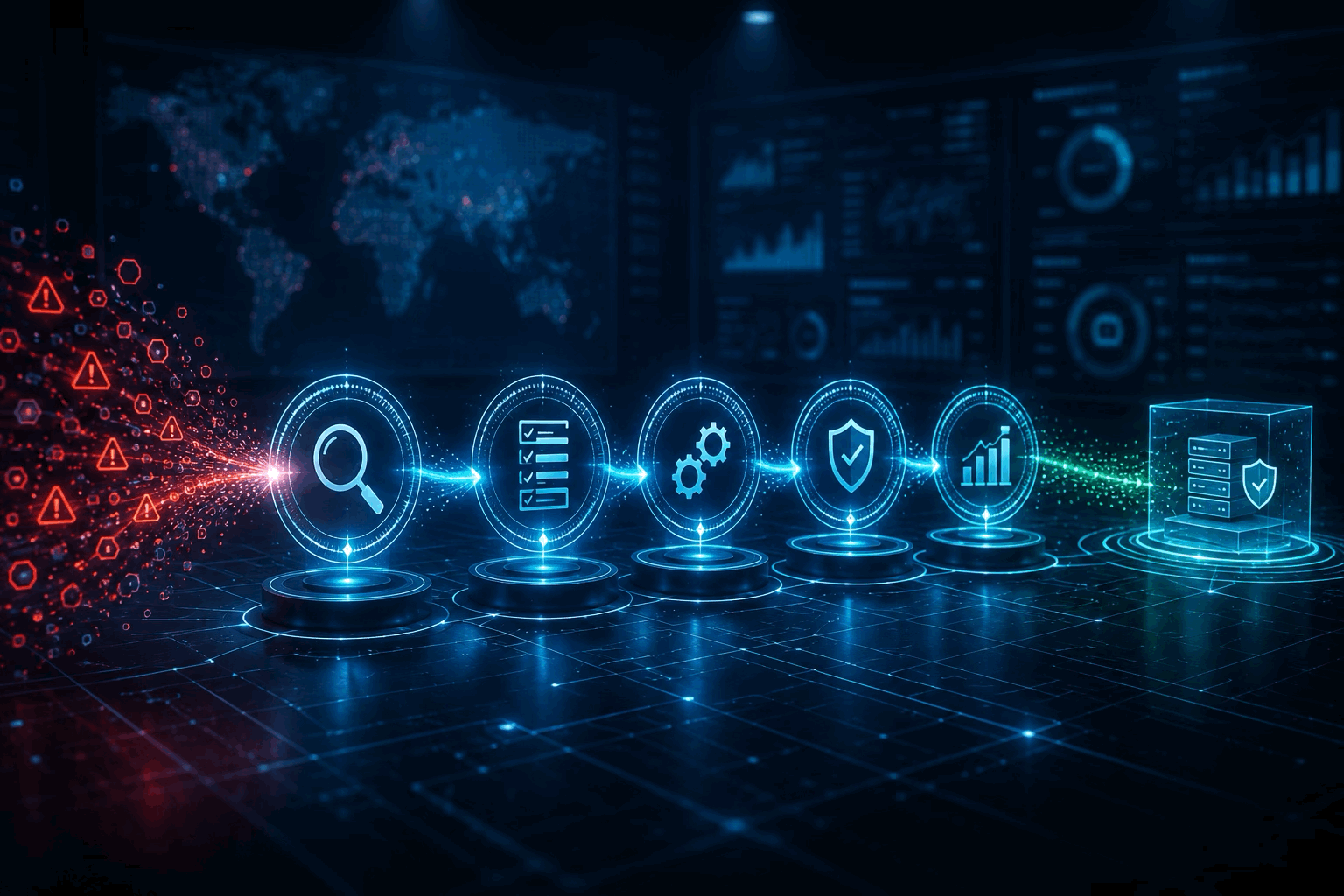
The remediation bottleneck is not simply a patching problem. It is a chain of activities, and every link matters. First, the organization needs to understand whether the finding is valid. Then it needs to understand whether it is exploitable in its own environment. Then it needs to know which asset, service, application, supplier or business process is affected.
Then someone must own the fix.
Then the fix must be created or obtained.
Then it must be tested.
Then it must go through change management.
Then it must be deployed safely.
Then someone must verify that the exposure has actually been reduced.
This is a lot of work.
It is also where the numbers become uncomfortable. Mean time to remediate remains above 50 days in many environments, while highly exploitable vulnerabilities may remain open for much longer. Edgescan’s 2026 research points to high and critical application vulnerabilities taking around 55 days to remediate, while other exposure-management research highlights that highly exploitable vulnerabilities can take an average of 134 days to remediate.
That gap is the problem. If the number of findings grows faster than the organization’s ability to process and remediate them, the backlog grows. If the backlog grows without prioritization, risk becomes harder to explain and harder to manage.
During a May 2026 Gartner webinar on OpenAI Daybreak and Claude Mythos, one point strongly resonated with me: AI models are progressing quickly in the early stages of the chain — scanning, discovering vulnerabilities and validating issues. But the response side is still much harder: planning remediation, creating a safe fix, testing for regressions and deploying through the teams that actually own the code or infrastructure.
This is the part that executives sometimes underestimate.
Attackers need speed and opportunity.
Defenders need speed, accuracy, safety, continuity and accountability.
An exploit only needs to work.
A fix needs to work without breaking the business.
Why IT Becomes the Front Line
This is why Claude Mythos and OpenAI Daybreak are not only security topics. They are IT operating model topics. Security can identify exposure. Security can prioritize. Security can advise. Security can monitor risk and challenge delays.
But in most organizations, Security does not own every system, every codebase, every cloud configuration, every network device, every database, every third-party platform or every business application. Remediation is executed by IT, development, infrastructure, cloud, platform, endpoint, network, application and supplier-management teams.
That means IT becomes the front line of AI-accelerated exposure management.
For infrastructure teams, the pressure may appear as more urgent patches for operating systems, middleware, VPNs, firewalls, databases, endpoint components and security appliances. This is already visible in large vendor patch cycles. A single operating system or mobile platform update can include dozens of security fixes. One example discussed in the Daybreak and Mythos webinar was an iOS release with more than 50 vulnerability fixes in one cycle. That may increasingly become the norm rather than the exception.
For development teams, the pressure may appear as more findings in custom code, APIs, libraries and software dependencies. The challenge will not only be to fix the bug, but to fix it without slowing delivery or introducing regressions.
For cloud and platform teams, the pressure may appear as more focus on misconfigurations, exposed services, identity paths, secrets and internet-facing assets. In many cloud environments, a vulnerability is only one part of the story. The real risk often comes from the combination of exposure, permissions, poor segmentation and weak monitoring.
For supplier and vendor-management teams, the pressure may appear as a need to understand which third-party providers can patch quickly, which cannot, and which dependencies create unacceptable exposure.
This is also where open source becomes very relevant. Modern enterprise software is rarely built only from internally written code. It is built from internal code, third-party components, SaaS platforms, commercial products, open-source libraries and cloud-native services.
Black Duck’s 2026 open-source research reported that open source is present in 98% of audited codebases and that the average number of open-source vulnerabilities per codebase more than doubled year over year. These numbers should not surprise anyone working close to modern software delivery, but they should remind us that open-source governance, software composition analysis and dependency management are now core parts of cyber resilience.
So exposure reduction cannot be managed by Security alone. It must be embedded into the way IT and engineering operate.
Patch Testing Becomes a Resilience Capability
One of the most important implications of AI-assisted vulnerability discovery may be an increase in patch frequency. If vendors, open-source maintainers and security providers use AI to find and fix more issues, customers may receive more patches, more often. That is positive from a security perspective, but it also creates operational pressure.
More patches mean more testing.
More testing means more effort.
More effort means more decisions around priority, downtime, regression risk and rollback.
The volume is already increasing. In the Gartner Daybreak and Mythos webinar, a reference was made to vulnerability growth of 33% in the first quarter of 2026 and 263% over five years. Whether every organization experiences that increase in the same way is less important than the direction of travel: the amount of vulnerability and patch activity is not getting smaller.
One practical example from the same discussion stood out to me. An organization decided to increase investment in patch testing because it expected more patches, potentially less stable patches, and did not want to extend testing timelines or damage production stability. This is exactly the kind of thinking we need.
Patch testing should not be seen as administrative friction. In this new environment, it becomes a resilience capability.
Can we test faster?
Can we deploy safely?
Can we roll back quickly?
Can we patch critical internet-facing systems differently from low-risk internal systems?
Can we apply emergency changes without losing control?
Can we validate that the fix actually reduced exposure?
These are not just operational questions. They are cyber resilience questions.
For regulated organizations, this is even more important. We cannot simply push changes blindly into production because a model found something. Availability, customer impact, compliance, operational risk and security all need to be balanced.
Speed matters. But safe speed matters more.
From Severity Scores to Time-Based Exposure Reduction
Another important shift is the move away from severity-only thinking. CVSS is useful, but it is not enough. A high-severity vulnerability on an isolated system may be less urgent than a medium-severity vulnerability exposed to the internet, connected to a critical business service and combined with weak identity controls.
This is where exploitability, exposure and business context matter. The challenge is that exploitability validation is still hard. Research on CTEM programs suggests that 96% of organizations still struggle to validate exploitability, and that 42% of security operations time is spent on findings that are never validated.
That is not only a tooling problem. It is a prioritization and workflow problem.
This is why tools such as EPSS, threat intelligence, adversarial validation, attack-path analysis and business service mapping matter. None of them is perfect alone. But together they help move prioritization beyond static severity.
The better question is not only:
“How severe is this vulnerability?”
The better question is:
“Where does exploitable exposure remain open long enough to become a business event?”
This is where I believe exposure management must evolve.
We need to focus less on the volume of findings and more on the duration of meaningful exposure. Which assets remain exploitable? For how long? Who owns them? What business service do they support? Are they internet-facing? Are they connected to privileged access? Are they protected by compensating controls? Has remediation been verified?
This is a different conversation from traditional vulnerability management. It moves the discussion from static scoring to decision-making. It moves the focus from “how many vulnerabilities do we have?” to “how long does material exposure remain open?”
And it moves accountability from Security reporting to operational ownership.
Ownership Is the Hardest Control to Automate
The most significant bottleneck in exposure management is not always a technology gap. Very often, it is an accountability gap.
Without named owners at the asset, service and application level, findings can circulate without resolution. Security teams can prioritize, escalate and report. But if the team that owns the system has different incentives, different deadlines or no clear remediation SLA, the exposure remains open.
This is why ownership needs to be explicit.
Who owns the asset?
Who owns the application?
Who owns the supplier relationship?
Who owns the remediation decision?
Who accepts the residual risk if remediation is delayed?
This is not bureaucracy. It is operational clarity. Security can guide prioritization and challenge the risk. But exposure is reduced by the teams that build, operate and change the environment.
That is why AI will not solve ownership by itself. It may help find issues faster. It may help suggest fixes. It may help generate detection logic. But it cannot replace the need for accountable teams, agreed remediation timelines and business-aligned decision-making.
AI Helps, But It Is Not Magic
OpenAI Daybreak is interesting because it moves the conversation beyond finding vulnerabilities. It points toward AI-assisted validation, detection logic and remediation support. That direction is important because the market needs help across the full remediation chain, not only at the discovery stage.
But cybersecurity leaders should remain pragmatic.
AI-generated findings need validation.
AI-generated fixes need testing.
AI-generated detection logic needs tuning.
AI-assisted remediation needs governance.
There are also very practical questions.
How much will this cost at scale?
Where does the source code go?
How are repositories copied or processed?
How are results retained?
How does the tool integrate with existing SAST, DAST, SCA, ticketing, CI/CD and change workflows?
Does it improve outcomes, or does it simply create another queue?
The cost point should not be underestimated. In Anthropic’s OpenBSD example, the reported cost to scan the codebase was around $20,000. In enterprise environments with many applications, repositories, third-party components and continuous scanning needs, cost, scope and repeatability will matter.
Another point from the same Gartner webinar discussion that I fully agree with is that the harness and workflow around the model may be as important as the model itself. Throwing a frontier model at a codebase is not the same as having a mature security testing and remediation process. This is why I would not rush to replace existing application security or exposure management tools simply because a frontier model is now available.
Test it.
Benchmark it.
Compare it.
Use it where it adds value.
But do not confuse adoption of an AI security tool with modernization of the security operating model.
AI can accelerate remediation. It cannot replace accountability for production change.
Compensating Controls Buy Time, But They Are Not the Finish Line
In a perfect world, every critical vulnerability would be patched immediately. In the real world, some patches are not available. Some are risky. Some require business downtime. Some depend on vendors. Some systems are legacy. Some environments cannot be changed quickly without creating operational risk.
This is where compensating controls matter.
Virtual patching, WAF rules, IPS signatures, EDR containment, segmentation, identity restrictions and enhanced monitoring can all help reduce risk while permanent remediation is prepared.
This distinction is important. Compensating controls are not an excuse for slow remediation. They are a way to buy time for safe remediation.
In an AI-accelerated environment, this becomes critical. If exploitation can move faster, then the ability to deploy temporary protection quickly becomes valuable. But those protections must be tracked, owned and eventually replaced by permanent fixes. Otherwise, temporary risk acceptance becomes permanent exposure.
And we have all seen how easily “temporary” can become permanent in enterprise environments.
What Security and IT Should Do Now
The current attention around Claude Mythos and OpenAI Daybreak should not be wasted on fear or isolated AI tool investments. It creates a useful window to address long-delayed improvements in exposure management, ownership and remediation workflows.
The response does not need to start with panic or with a large AI procurement decision. It should start with operating discipline.
First, map critical business services to the technology assets that support them. It is very difficult to prioritize exposure if the organization cannot connect systems to business impact.
Second, prioritize based on exploitability, exposure and business criticality, not only severity. Internet-facing systems, privileged access paths, critical business services and known exploited vulnerabilities should receive different treatment.
Third, assign clear ownership. Security can guide and challenge, but remediation must be owned by the teams that build, operate or manage the affected systems.
Fourth, strengthen patch testing and rollback. Faster remediation is not only about pushing changes faster. It is about changing safely, with confidence.
Fifth, integrate remediation into existing IT and engineering workflows. Findings should not live in a separate security universe. They should flow into the queues where work is actually planned and executed.
Sixth, prepare compensating controls in advance. WAF, IPS, EDR, segmentation, ZTNA, identity restrictions and monitoring should be ready to reduce exposure when direct patching cannot happen immediately.
Seventh, test AI tools carefully. Use proof-of-concepts on controlled scopes. Measure accuracy, false positives, fix quality, cost, privacy, integration and developer acceptance.
Finally, measure exposure reduction. Not only how many vulnerabilities were found. Not only how many tickets were opened. But how long meaningful exposure remained open, who owned it, and whether remediation was verified.
That is the shift. From finding to fixing. From volume to exposure reduction. From security reporting to operational accountability.
Final Thought: The Real Advantage Is Operating Speed
Claude Mythos and OpenAI Daybreak are not only stories about AI models. They are signals that cybersecurity is entering a phase where vulnerability discovery may accelerate faster than enterprise remediation capacity. That does not mean organizations should panic. It does mean they should use this moment wisely.
The Mythos and Daybreak discussion gives security leaders an opportunity to address something many already knew: the hard part is rarely finding the issue. The hard part is deciding what matters, assigning ownership, testing the fix and changing production safely.
In my view, the organizations that respond well will not be the ones that generate the longest vulnerability lists. They will be the ones that can reduce meaningful exposure faster, safer and with clearer accountability.
In the AI era, the advantage will not belong to the organization that finds everything. It will belong to the organization that can decide, fix, test and recover before exposure becomes impact.

